Two South African businesses can borrow the exact same amount, from two different lenders, and end up paying wildly different totals for it, without either quote technically lying to them. One number gets marketed. A different number determines what actually leaves your bank account. If you have ever looked at two funding offers side by side and struggled to tell which one was actually cheaper, this guide exists to fix that, using the real rate environment as it stands in September 2026.
Start here: the SARB repo rate is the number everything else is built on
The South African Reserve Bank’s Monetary Policy Committee sets the repurchase, or repo, rate, which is what commercial banks pay to borrow from the Reserve Bank itself. As of the most recent Monetary Policy Committee decision, the repo rate sits at 7.00 percent, following a hike from 6.75 percent on 28 May 2026, the first increase in some time after a cut to 6.75 percent in November 2025. The next MPC decision lands on 23 September 2026, and it is genuinely live: the July vote split 4 to 2 in favour of holding, meaning a single member changing their view could tip the next decision toward another hike.
South Africa’s prime lending rate, the base rate banks use for lending to their most creditworthy customers, is calculated as the repo rate plus a standard 3.5 percent margin. At a 7.00 percent repo rate, prime currently sits at 10.50 percent. Every bank loan, and most alternative lender pricing indirectly, is benchmarked against this number, so when the repo rate moves, the cost of business borrowing across the entire market moves with it. You can check the current live rate at any time on our Market Intelligence tool.
Stop guessing. Start building.
We've built a free Business Idea Generator Tool that walks you through this exact framework and generates a professional Validation Report.
Access the Free ToolWhy alternative lenders charge more than prime, and why that is not automatically a bad deal
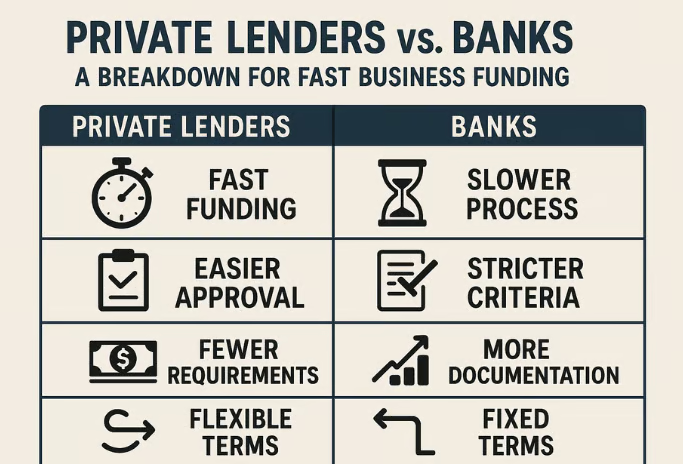
Bank lending priced near prime looks cheap on paper, but banks apply strict criteria: multiple years of audited financials, security, and turnover thresholds that exclude a large share of South African SMEs entirely. Alternative lenders exist to serve exactly the businesses banks turn away, and they price for that additional risk. In 2026, unsecured business loan pricing from alternative lenders typically ranges from 1 percent to 6 percent per month, working out to an annual percentage rate of roughly 12 percent to 72 percent, while broader alternative and online lending overall tends to cluster around 15 percent to 30 percent APR for better-qualified borrowers, according to current South African lending market data. A merchant cash advance or short-term bridging facility usually sits toward the higher end of that range, reflecting speed of access and lack of security rather than the lender being deliberately punitive.
The honest way to think about this: a 40 percent APR facility that gets R500,000 of stock into your shop before the festive season, generating R900,000 in incremental sales, is a good deal despite the headline rate looking high. The same rate used to plug an ongoing cash flow gap with no clear payoff is a bad deal, regardless of how it is marketed. Rate alone never tells you whether a facility is right for your business; what the money achieves does.
The four numbers that actually determine what you pay
Comparing funding offers properly means looking past the headline interest rate to four things:
- The interest rate itself, and critically, whether it is quoted monthly or annually. A “3 percent” rate quoted monthly is very different from 3 percent annually, and this is the single most common source of confusion when comparing offers.
- Initiation and origination fees, typically a percentage of the loan amount charged upfront, which increase your effective cost beyond the interest rate alone.
- Monthly service or admin fees, charged for the life of the facility regardless of the interest rate, which matter more on longer-term facilities where they compound over many months.
- The repayment term. A shorter term at a higher monthly rate can cost less in total than a longer term at a lower monthly rate, which is exactly why comparing rates alone, without running the full repayment schedule, misleads more often than it helps.
The only reliable way to compare two offers is to add all four together and look at the total repayment amount, not the rate. Our Business Funding Cost Comparison tool does exactly this, letting you see the true cost, in Rands, of a term loan, invoice finance, merchant cash advance and revolving credit side by side.
Worked example: same amount, three structures, three very different totals
Take a R400,000 facility over 12 months, compared across three realistic 2026 structures:
- Bank term loan near prime, roughly 12.5 percent per year plus a modest initiation fee: total repayment around R427,000, but typically requiring 2 or more years of financials, security, and a multi-week approval process.
- Alternative lender unsecured term loan at a representative 2.5 percent per month: total repayment around R520,000, approved within days against 12 months of bank statements rather than audited financials.
- Merchant cash advance structured against card sales at an equivalent 4 percent a month: total repayment around R592,000, but with repayments that automatically shrink in a slow month rather than demanding a fixed instalment regardless of trading conditions.
None of these is objectively “the best” option. The bank loan is cheapest if you qualify and can wait. The alternative lender sits in the middle on both cost and speed. The merchant cash advance costs the most but removes fixed-repayment risk entirely. Choosing correctly depends on your actual situation, not the rate in isolation, which is exactly what our Business Loan Repayment Calculator is built to show you on your own numbers.
Effective interest rate versus the rate you get quoted
The rate a lender advertises is rarely the full story. Once initiation fees and monthly service fees are folded in, the effective annual cost of a facility is almost always higher than the headline number suggests, sometimes significantly. This is not necessarily deceptive; it reflects how these products are legally required to be structured and disclosed under the National Credit Act for applicable facilities. It does mean you should never compare two offers on quoted rate alone. Ask directly for the total repayment amount in Rands, for the exact term you are being offered, before accepting anything.
Free Tools Mentioned
Access our interactive calculators to simulate your specific business numbers.
Unlock All Tools FreeDebt versus equity: the cost comparison that is not about interest rates at all
Every cost discussed so far assumes debt: you borrow, you repay with interest, and you keep full ownership. Equity funding has no interest rate at all, which can make it look cheaper on the surface, but the real cost is a permanent share of every future rand your business earns, for as long as you own it. A R500,000 equity investment for 15 percent of your business could easily cost far more than R500,000 in debt financing over a five or ten year horizon, if the business grows meaningfully. We break this comparison down fully in our complete guide to business funding options, and our Equity vs Debt Calculator runs the actual numbers for your situation.
How to negotiate, or at least ask the right questions
Alternative lender pricing in South Africa is not always fixed. A stronger trading history, higher monthly turnover, or an existing relationship with a lender can sometimes move pricing, particularly on repeat facilities. At minimum, always ask for the total repayment figure in Rands, whether the rate is fixed or reviewable, what happens if you repay early, and whether there is any penalty for doing so. A facility that lets you repay early without penalty is worth more than the headline rate suggests, especially if your cash flow situation might improve faster than expected.
The bottom line
Cost of capital in South Africa in 2026 starts from a 7.00 percent repo rate and a 10.50 percent prime rate, and builds upward from there based on how much risk a lender is taking on by saying yes to your business. The number that matters is never the headline rate. It is the total Rand amount you repay, for the specific amount and term you actually need, compared honestly across every option available to you. That comparison takes minutes with the right tools, and it is the difference between a facility that grows your business and one that quietly drags on it.
See what you actually qualify for, and at what real cost, with our 60-second funding qualifier.
Frequently asked questions
Is a lower monthly interest rate always the cheaper option?
Not necessarily. Fees and the total repayment term matter as much as the rate itself. Always compare the full repayment amount in Rands, not the rate alone.
Why do alternative lenders charge more than banks?
They serve businesses that cannot meet bank criteria, often without security or multiple years of audited financials, and price to reflect that additional risk.
Can I repay a business loan early to save on interest?
This depends entirely on the lender and product. Some allow early settlement without penalty; others do not. Always confirm this before signing, since it can materially change the total cost if your cash flow improves faster than expected.
What happens if the SARB repo rate changes after I have taken out a loan?
Fixed-rate facilities, common with many alternative lenders, are unaffected. Variable-rate facilities, more common with banks, will adjust with prime, which is why it is worth confirming which structure you are being offered.
Related guides
- The Complete Guide to Business Funding in South Africa
- The Complete Guide to Getting Your Business Funding-Ready
- The Complete Guide to Government Grants for South African SMEs
- The Complete Guide to B-BBEE and Business Funding
Need Startup Capital?
If your business is already trading, check your eligibility for up to R5M in unsecured funding.
Check Eligibility