A restaurant group in Sandton turning over R680,000 a month and a solar installer in Durban turning over R220,000 a month both typed “business funding South Africa” into Google last month. They needed completely different products, from completely different lenders, on completely different terms. Most articles on this topic treat funding as one thing. It is not. It is a set of distinct tools, each built for a specific cash flow problem, and picking the wrong one is one of the most common and most expensive mistakes a South African business owner makes.
This guide covers every major funding type available to South African SMEs in 2026, what each one actually costs, who qualifies, and how to work out which one fits your business specifically. If you would rather skip the reading and just see what you qualify for right now, our 60-second funding qualifier will score your business against real lender criteria and match you directly.
Why “business funding” is not one product
Every funding type exists to solve a specific problem. A term loan solves a one-off capital need. Invoice finance solves a timing gap between doing the work and getting paid for it. A revolving credit facility solves unpredictable, recurring cash flow dips. Confusing these is how businesses end up over-borrowing for a short-term problem, or locking into long-term debt for something that needed a three-month bridge.
Stop guessing. Start building.
We've built a free Business Idea Generator Tool that walks you through this exact framework and generates a professional Validation Report.
Access the Free ToolBefore comparing products, it helps to be honest about which of these three situations you are actually in:
- You need a lump sum for a specific purpose (equipment, expansion, stock for a big order) that will pay for itself over time. This points toward a term loan or asset finance.
- You have done the work but are waiting to be paid, and the wait is starving your cash flow. This points toward invoice finance or purchase order finance.
- Your cash flow is unpredictable month to month and you need a safety net you can dip into and repay repeatedly. This points toward a revolving credit facility or a business overdraf.
Term loans: the default, and when it actually fits
A term loan is the product most people picture when they hear “business loan”: a lump sum, repaid in fixed instalments over a fixed period, usually 3 to 24 months from alternative lenders and up to 5 years or more from banks. In South Africa in 2026, unsecured business loan pricing from alternative lenders typically runs 1 percent to 6 percent per month, which works out to an annual percentage rate of roughly 12 percent to 72 percent depending on your risk profile, according to Yalu’s 2026 unsecured lending data. Bank-backed and secured facilities sit at the lower end of that range; short-term, unsecured, higher-risk facilities sit at the top.
A term loan makes sense when the money is going toward something with a clear, calculable return: a second location, a piece of equipment that increases output, stock for a contract you have already won. It makes far less sense as a way to plug an ongoing cash flow gap, because you are locking in a fixed monthly repayment against a problem that is not fixed.
Worked example. A logistics business turning over R450,000 a month needs R600,000 to buy a second delivery vehicle that will let it take on a new retail contract worth R95,000 a month. At a representative alternative-lender rate of 3 percent a month over 12 months, the total repayment lands around R816,000, meaning the vehicle effectively costs R216,000 in financing on top of its price. Against R95,000 a month in new contracted revenue, that cost is recovered in well under three months of the new business alone. That is what a term loan looks like when it fits.
Our Funding Repayment Calculator will run this math on your own numbers in under a minute.
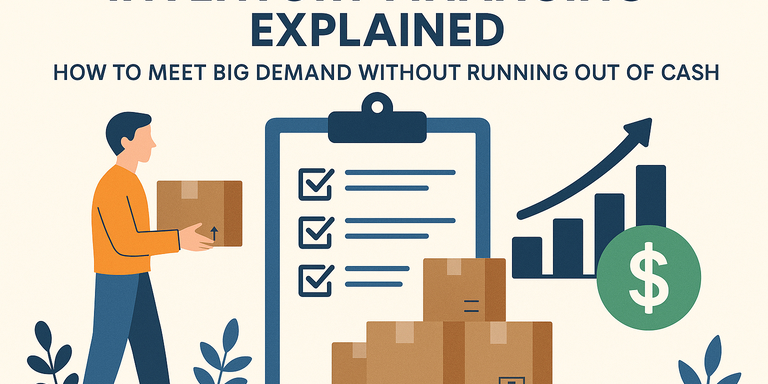
Invoice finance and invoice discounting: get paid for work you have already done
If your business regularly waits 30, 60 or even 90 days to get paid by customers, invoice finance turns that waiting time into cash. A lender advances you a percentage of an outstanding invoice, usually 70 percent to 90 percent, immediately, and pays the remainder (minus fees) once your customer settles. There are two structures worth knowing apart:
Free Tools Mentioned
Access our interactive calculators to simulate your specific business numbers.
Unlock All Tools Free- Invoice discounting is confidential. Your customer never knows a financier is involved; you still manage collections yourself.
- Invoice factoring is disclosed. The financier takes over collections directly from your customer, which some business owners are uncomfortable with, particularly with long-standing client relationships.
This is arguably the most underused funding type among established South African SMEs, because it is tied to revenue you have already earned rather than a lump sum you have to justify and repay regardless of trading conditions. It is particularly well suited to B2B service businesses, manufacturers and suppliers to large corporates or government, where 60-day payment terms are standard and genuinely painful.
Our Invoice & Purchase Order Finance Calculator will show you exactly how much cash a specific invoice could release right now.
Revolving credit and business overdrafts: the safety net for unpredictable cash flow
A revolving credit facility, sometimes structured as a business line of credit, gives you access to a set limit that you draw down and repay as needed, paying interest only on what you actually use, similar to a credit card but sized for a business. This is the right tool when your cash flow is genuinely variable rather than facing one big, identifiable gap: seasonal stock businesses, businesses with irregular client payment timing, or anyone who wants a buffer against load shedding disruptions or a slow month without taking on a full term loan every time.
A traditional bank overdraft does something similar but is usually harder to access for younger or smaller businesses, and banks can reduce or call in an overdraft facility with relatively short notice, which is worth knowing before you rely on one as your primary safety net.
Merchant cash advances: fast, expensive, and tied to your card sales
A merchant cash advance gives a retailer or hospitality business an upfront lump sum in exchange for a fixed percentage of future card sales until the advance, plus a fee, is repaid. Because repayment scales with sales, it never demands a fixed instalment you cannot afford in a slow month, which is the main appeal. The trade-off is cost: merchant cash advances sit toward the more expensive end of the funding spectrum, so they suit a genuine short-term need with a clear payoff, such as festive season stock, rather than an ongoing working capital solution.
Asset finance: fund the equipment, not your whole business
If the funding need is a specific, identifiable asset such as machinery, a vehicle or equipment, asset finance lets the asset itself secure the loan, which typically brings the interest rate down compared to an unsecured facility and does not touch your general working capital line. The lender retains an interest in the asset until it is paid off, similar to vehicle finance for a personal car. This is generally the cheapest way to fund equipment specifically, and mixing it up with a generic unsecured term loan for the same purpose usually costs you more than it needs to.
Trade and supply chain finance: for importers, exporters and suppliers
Businesses that import stock, export goods, or supply large corporates with long payment terms have a distinct set of financing needs: paying an overseas supplier before goods arrive, covering the gap between shipping and sale, or financing the wait between delivering to a large customer and being paid on their terms. Trade finance and supply chain or purchase order finance products exist specifically for these situations, and are frequently misunderstood or overlooked by businesses that default to a generic term loan instead.
Government funding: grants, not loans, and a name change worth knowing
If your business qualifies, non-repayable grants and government-backed development finance are the cheapest capital available, because you are not paying interest on it at all. The most important update here for 2026: the Small Enterprise Finance Agency (SEFA) merged with the Small Enterprise Development Agency (Seda) and the Cooperative Banks Development Agency in October 2024 to form the Small Enterprise Development and Finance Agency, or SEDFA. If you have seen “SEFA” referenced elsewhere, including in older articles, that is now SEDFA, with applications running through sedfa.org.za and loan and grant-linked amounts running from R50,000 to R15 million depending on the programme. We cover this in full, including eligibility and how the application process actually works, in our complete guide to government grants for South African SMEs.
Equity: giving up a piece of the business instead of taking on debt
Every funding type so far is debt: you borrow, you repay, with interest, and you keep 100 percent ownership throughout. Equity funding is different. An investor puts capital into your business in exchange for a percentage of ownership, and there is no fixed repayment. That sounds appealing when cash flow is tight, but it means giving up a share of every rand your business ever earns from that point forward, plus some level of decision-making control, for as long as you own the business.
As a rough rule, equity tends to make more sense for high-growth, capital-intensive businesses (particularly in tech) that need far more capital than their current revenue could ever service as debt, while debt tends to make more sense for an established, profitable business that can comfortably service repayments and wants to keep full ownership. Our Equity vs Debt Calculator puts real numbers behind that decision for your specific situation.
What South African lenders actually check before saying yes
Regardless of which product you pursue, most lenders assess the same core things, just weighted differently by product type:
- Monthly turnover, usually verified via 3 to 6 months of bank statements, is the single biggest driver of how much you can borrow.
- Time trading. Most alternative lenders want 12 months minimum; some want 24. A business under 12 months old will struggle to access most of the products above and should look at our guide to becoming funding ready first.
- Registration and compliance. A registered CIPC entity with SARS compliance in order is a baseline requirement almost everywhere.
- Existing debt and repayment history. A business already carrying multiple facilities will be assessed more cautiously, or declined, regardless of turnover.
How to actually decide, in three questions
Strip away the product names and the decision comes down to three questions: what is the money actually for, how predictable is your cash flow, and how much does your business currently turn over each month. Answer those honestly and the right product usually becomes obvious, which is exactly what our Funding Matchmaker tool does in about two minutes, matching your specific situation to the funding type and lender criteria most likely to say yes rather than leaving you to guess.
If you would rather see this applied to your own numbers right now, our 60-second funding qualifier scores your business against real lender criteria and routes you directly to a matched partner, with no impact on your credit score and no documents required to get your first result.
Frequently asked questions
What is the fastest type of business funding to get in South Africa?
Merchant cash advances and unsecured term loans from alternative lenders are typically the fastest, often paying out within 24 to 48 hours of approval, since they rely on bank statements rather than audited financials.
Can a business under 12 months old get funding in South Africa?
Most alternative lenders require at least 12 months of trading history, though some unsecured products accept 6 months. A business under 6 months old will generally need to look at government-backed or development finance options instead.
Is invoice finance the same as a business loan?
No. Invoice finance advances you money against revenue you have already earned but not yet been paid for, so it is not new debt in the same sense as a term loan, and the amount available scales with your actual sales rather than a fixed approved limit.
How much can my business actually borrow?
Most lenders size an offer as a multiple of your average monthly turnover, typically between 1 and 3 times monthly turnover for unsecured products, though this varies significantly by lender and trading history.
Related guides
- The Complete Guide to Getting Your Business Funding-Ready
- The Complete Guide to Business Loan Costs and Interest Rates in South Africa
- The Complete Guide to Government Grants for South African SMEs
- The Complete Guide to B-BBEE and Business Funding
Need Startup Capital?
If your business is already trading, check your eligibility for up to R5M in unsecured funding.
Check Eligibility