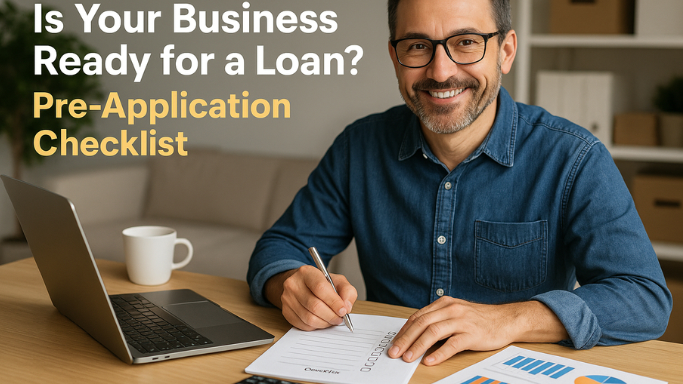
Roughly 85 percent of first-time business loan applications in South Africa get declined, and in the overwhelming majority of those cases the business itself was fundable. What sank the application was preparation: a lapsed CIPC filing, a SARS account not up to date, bank statements that did not clearly show real trading activity, or simply applying to a lender whose criteria the business was never going to meet. Getting funding-ready is not about becoming a bigger or better business. It is about making the business you already have legible to a lender in the language they actually assess it in.
This guide walks through exactly what that means, in the order a lender actually checks it, so you can fix what needs fixing before you apply rather than finding out after a decline shows up on record. If you want a straight answer on where you stand right now, our Funding Readiness tool scores your business against the same criteria lenders use, in about two minutes.
Step 1: your CIPC registration has to be current, not just done
Being registered with the Companies and Intellectual Property Commission is the baseline, but registration alone is not enough. Lenders check that your annual returns are up to date, because a company that has fallen behind on CIPC filings signals administrative risk regardless of how well the business itself is actually performing. If you are not certain your CIPC status is clean, this is the single fastest thing to check and fix, since filing a late annual return typically takes days, not weeks. Our CIPC Compliance & Funding-Readiness Check walks through exactly what to verify and links directly to the official CIPC BizPortal to fix anything outstanding.
Stop guessing. Start building.
We've built a free Business Idea Generator Tool that walks you through this exact framework and generates a professional Validation Report.
Access the Free ToolStep 2: SARS compliance, specifically a valid tax clearance status
A South African Revenue Service tax clearance, now issued as a “Tax Compliance Status” (TCS) PIN through SARS eFiling, confirms your business has no outstanding returns or debt with SARS. Almost every formal lender and every government funding programme, including SEDFA (formerly SEFA), requires this. It is worth checking your TCS status before you apply anywhere, not after, because resolving an outstanding SARS issue can take considerably longer than a CIPC filing, especially if it involves a payment arrangement or a dispute.
If your business is VAT registered, or should be, this is also the moment to confirm that status is correct: VAT registration becomes compulsory once your taxable turnover exceeds R1 million in any consecutive 12-month period, and getting this wrong in either direction, registering too late or claiming input VAT incorrectly, is a red flag lenders specifically look for in bank statements and financials. Our VAT Calculator & Registration Threshold Checker confirms where you stand in under a minute.
Step 3: bank statements that actually show what a lender needs to see
Most alternative lenders in South Africa base their entire turnover assessment on 3 to 6 months of business bank statements, not your financial statements or a business plan. This means the single biggest lever you control is making sure your banking reflects your real trading activity clearly:
- Run business income through a business account, not a personal one. A lender assessing a personal account for business turnover will discount it heavily or decline outright, because personal accounts mix income sources in ways that cannot be verified as genuine business revenue.
- Avoid large, unexplained cash deposits. These get flagged and typically excluded from a turnover calculation entirely, since a lender cannot verify they came from genuine trading.
- Keep owner drawings and loan injections separate and identifiable. Money you personally put into the business is not turnover, and a lender who cannot tell the difference will assume the worst and score your real trading activity lower.
- Maintain consistent, regular deposit patterns where your business genuinely allows it. Wildly erratic deposit timing, even at the same total monthly value, reads as higher risk than steady, predictable inflows.
Our AI Bank Statement Analyzer will read your actual statements and give you the same average monthly turnover figure a lender’s underwriting process would calculate, before you ever submit an application.
Step 4: know your real numbers before a lender tells you them
Two figures matter more than almost anything else in a funding application: your average monthly turnover over the last 3 to 6 months, and your months trading as a registered entity. Most lenders in South Africa set a minimum monthly turnover threshold somewhere between R20,000 and R50,000 depending on the product, and a minimum trading history of 12 months, sometimes 6 for smaller unsecured products.
Cash flow, not just turnover, is the other number worth knowing cold. A business with strong revenue but a genuine cash flow gap between paying suppliers and getting paid by customers looks different on paper to a lender than a business with weak revenue overall, and the funding solution for each is completely different, as covered in our complete guide to business funding options. Our Cash Flow Simulator will show you exactly when and why a gap might hit in the coming months, which is precisely the kind of foresight that makes an application read as well-managed rather than reactive.
Free Tools Mentioned
Access our interactive calculators to simulate your specific business numbers.
Unlock All Tools FreeStep 5: B-BBEE, especially if tenders or larger facilities are part of the plan
A current B-BBEE certificate or affidavit is not usually a hard requirement for a straightforward unsecured business loan, but it matters significantly if you are pursuing larger facilities, government-linked funding, or any business that supplies corporates or the public sector, where B-BBEE level directly affects both funding access and tender eligibility. We cover exactly how this works, including the 2026 draft amendments currently under public comment, in our complete guide to B-BBEE and business funding. Our B-BBEE Optimizer shows which scorecard elements would move your business up a level fastest.
Step 6: gather the standard document set before you need it
Requirements vary by lender and product, but the standard set most South African lenders ask for includes:
- CIPC registration documents and, where applicable, a company or CC founding statement
- A valid SARS Tax Compliance Status PIN
- 3 to 6 months of business bank statements
- Director or member identification documents
- A current B-BBEE certificate or affidavit, where relevant to the facility size or funding type
- Management accounts or annual financial statements, for larger or longer-term facilities
Having this ready before you apply, rather than scrambling to source it mid-application, is one of the simplest ways to avoid an application stalling or timing out, which is one of the most common reasons a genuinely fundable business never actually completes the process. Our Funding Preparation Toolkit gives you the exact checklist for your situation.
Step 7: run a risk check before a lender runs theirs
Lenders assess more than just the numbers. Payment terms with your own customers, whether you have bounced any debit orders recently, cross-border transactions, and existing debt exposure all factor into an underwriting decision, often in ways business owners do not expect. Running your own business through the same lens a lender will, before you apply, lets you address a genuine weak point or at least prepare to explain it, rather than being blindsided by a decline. Our Pre-Application Risk Check flags exactly this, in 11 questions.
What if you are not quite ready yet
If your business is under 12 months old, turning over less than roughly R20,000 a month, or not yet CIPC registered, most of the funding types in our complete funding guide will not be accessible yet, and that is worth knowing honestly now rather than after a decline. The fastest path forward is usually growing turnover and trading history simultaneously while keeping compliance clean from day one, since a business that becomes fundable with a spotless compliance record moves through the process far faster than one that has to fix problems retroactively once turnover finally arrives.
Putting it together
Funding readiness is not a single number. It is CIPC current, SARS current, bank statements that clearly show real trading activity, B-BBEE sorted if it is relevant to what you are pursuing, and the standard document set ready to go. Get those seven things right and most declines that would otherwise happen for administrative reasons simply stop happening, leaving the actual funding decision to rest on whether your business genuinely fits a lender’s criteria, which is a far better problem to have.
See exactly where your business stands right now with our 60-second funding qualifier, free, with no documents required and no impact on your credit score.
Frequently asked questions
How long does it take to become funding-ready if I am starting from nothing?
CIPC and SARS compliance can often be sorted within a week or two if nothing is seriously outstanding. Building 12 months of clean trading history is the part that cannot be rushed.
Does a declined application hurt my chances with other lenders?
A soft check used for pre-qualification typically does not affect your credit score. A full application with a hard credit check can appear on your credit profile, which is one reason it pays to prequalify honestly before submitting a full application.
Do I need a business plan to apply for funding?
For most commercial and alternative lender products, no. They rely on bank statements and trading history. Government and development finance programmes generally do require one.
What is the minimum monthly turnover most lenders want to see?
It varies by lender and product, but most unsecured business funding in South Africa sets a floor somewhere between R20,000 and R50,000 in average monthly turnover.
Related guides
- The Complete Guide to Business Funding in South Africa
- The Complete Guide to Business Loan Costs and Interest Rates in South Africa
- The Complete Guide to Government Grants for South African SMEs
- The Complete Guide to B-BBEE and Business Funding
Need Startup Capital?
If your business is already trading, check your eligibility for up to R5M in unsecured funding.
Check Eligibility